Charlie's Chosen Family
I was sitting at my desk, working on a book chapter on the sociology of the family, when an email arrived. It came as I was writing a paragraph about ‘chosen families’, a concept made popular by American anthropologist Kath Weston during the 1990s. Weston suggested that as queer people have forged families outside of relationships of blood or marriage, they have (intentionally or unintentionally) redrawn the boundaries of kinship. The email was from a descendent of Wellington's Hill family, a number of whom were friends of chemist and photographer Robert Gant during the 1870s – and for decades afterwards. There was an attachment too: a photo of a young man sitting on a grassy sward next to a wooden villa. Smartly dressed in a roll-neck sweater and turned up trousers, he holds his left leg in his hands.
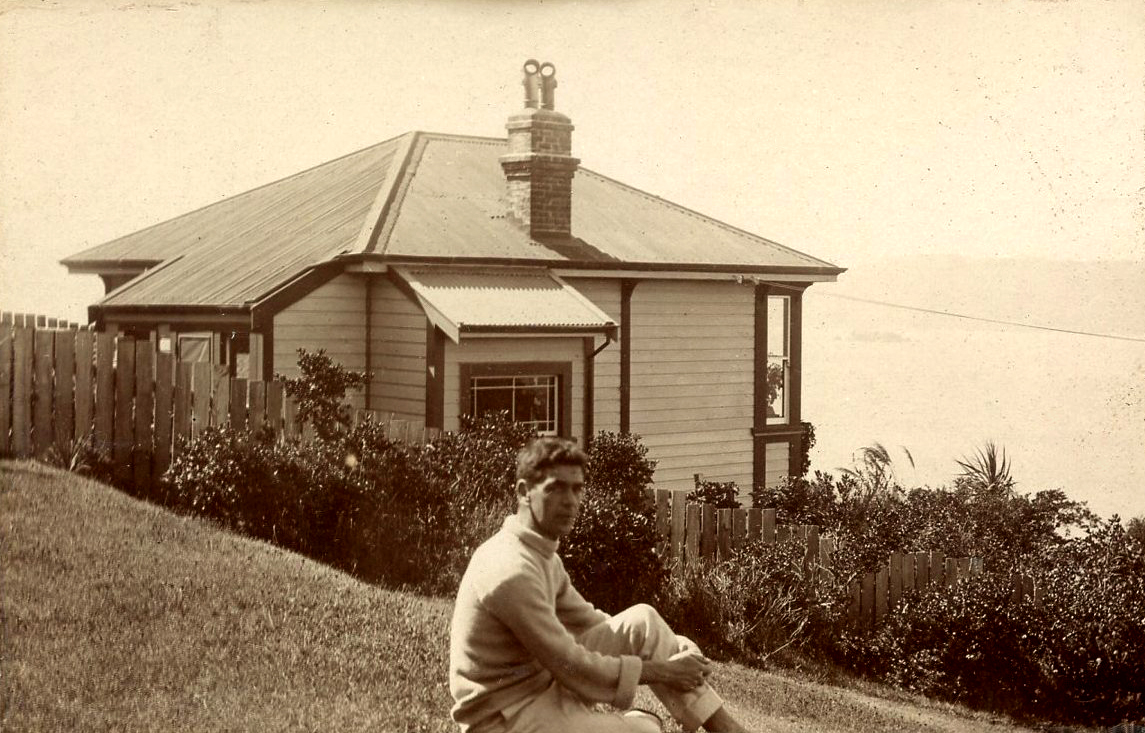
The caption below the photograph reads:
Charlie Haig [sic], not a relative but often around.
Although Charlie Haigh (with a final ‘h’) was not related to the writer of the caption – Elizabeth Mason, another member of the Hill family – it is hardly surprising he was ‘often around’: Charlie was Robert’s lover and partner for nearly thirty years.
In 1899, Robert had the wooden villa built for himself on the hill above Seatoun. It faced Wellington Harbour, with a view of Ward Island and Eastbourne. He named it Kahukura, and spent five years there before letting it out and moving to the Wairarapa town of Greytown. By then in his early fifties, he met Charlie, a butcher’s son in his late teens, the thirteenth of fourteen children in a devoutly Methodist family. When Robert returned to Seatoun in 1908, Charlie went with him.
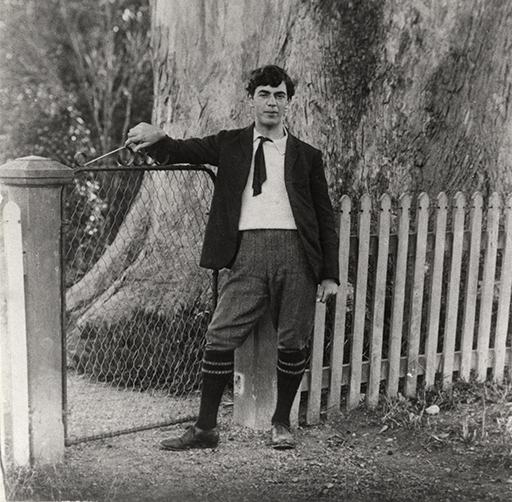
Young Charlie’s tie has slipped a bit in this photo at the gate, c.1905, probably taken by Robert. The same tie appears in the image below.
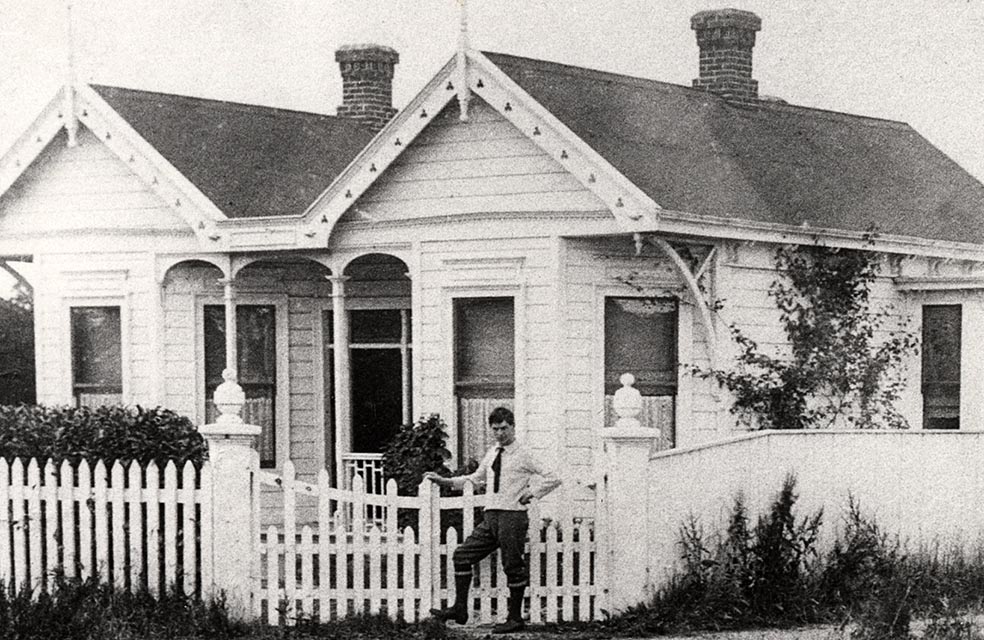
As I stared at the sepia photo of Charlie Haigh and Kahukura, I noticed a potted plant in the front window. I can picture Charlie and Robert sitting next to it and looking out at the harbour. The bookcases would have been well-stocked with periodicals – The Artist and The Studio contained a lot of homoerotic writing and imagery – and there were books about oil paintings, watercolours and etchings, and the literary classics. Robert’s own photographs riffed off famous works of art and literature, as well as religious themes [see here]. A large Bible, richly illustrated by Gustave Doré, was one of his prized possessions. There was music too, and good food. An accomplished piano player, Charlie played for Robert at home. Around town, he showed off his talents at the RSA’s Tin Hat Club, the Kakariki Savage Club, and the Wellington Orphans’ Club [see here]. According to one of Charlie’s relatives, ‘cooking was a hobby and he enjoyed entertaining friends and relatives with his home baking’.
Robert retired as a chemist soon after he and Charlie set themselves up in Seatoun, but Charlie had many years left in the workforce. He served customers at the dress fabric counter of the DIC, a department store in Brandon Street. The electric tram to town ran just eight minutes’ walk from the house, and I can imagine Charlie striding down the hill on his way to the tram stop, his jacket neatly buttoned and his trousers well pressed.
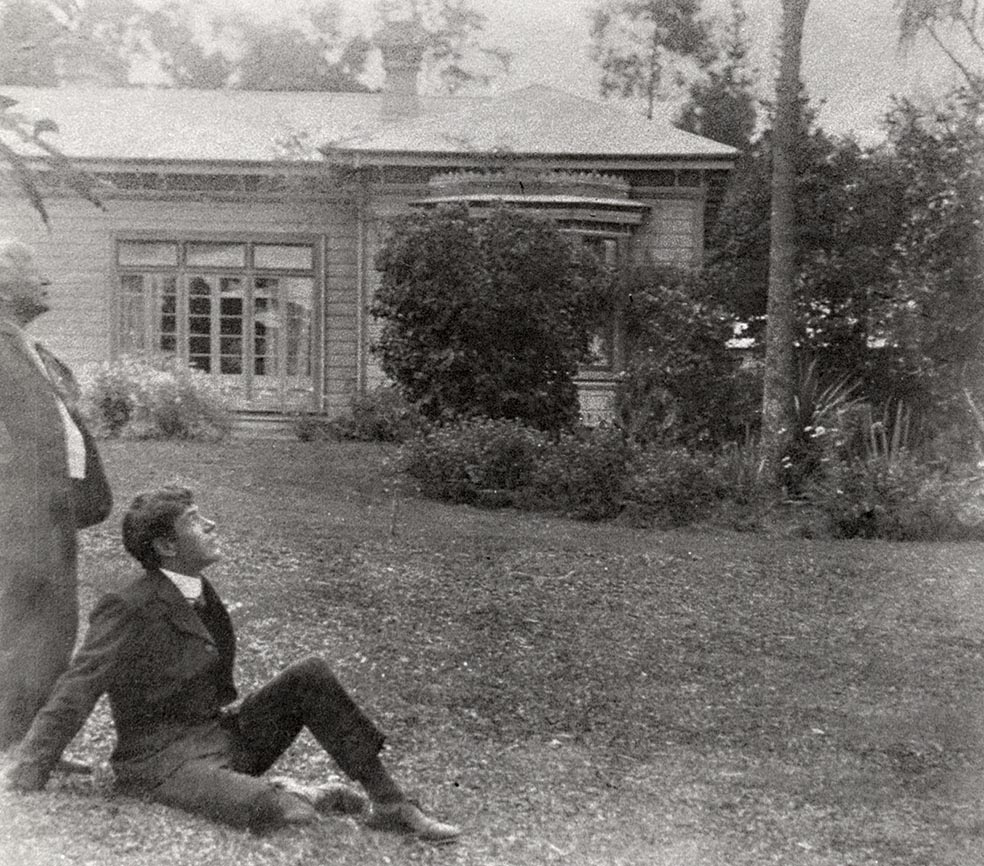
In the garden of Te Rakau Nui, Charlie props up his leg, as he would in the Seatoun photo. Robert stands behind him.
Robert and Charlie became each other’s chosen family, to use Weston’s term, but they were far from an isolated unit. The pair made friends among the neighbours, and on long weekends they travelled by train to visit members of the extended Haigh family in Greytown. Te Rakau Nui was the Haigh family homestead. One niece remembered ‘great sing-songs with mother on the organ and Uncle Charlie on the piano’. Charlie remained close to his sister Rose, the only sibling younger than him.
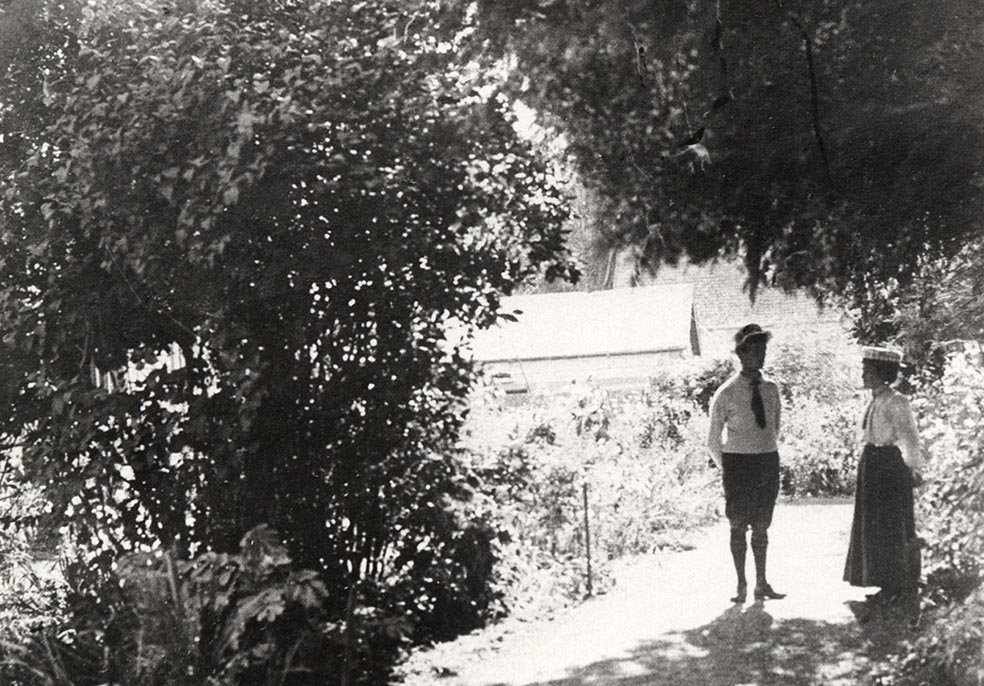
Charlie and a friend or relative in the extensive garden of Te Rakau Nui.
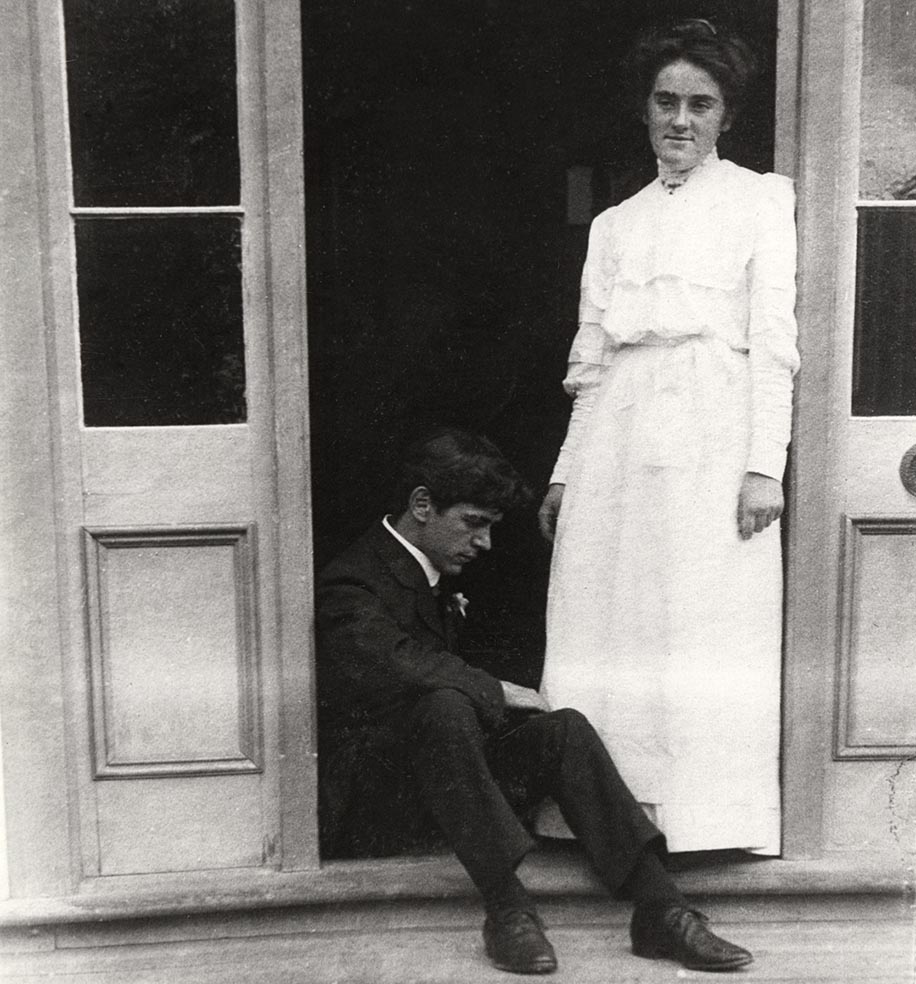
Charlie sits in the doorway of Te Rakau Nui alongside his sister Rose. She was two years younger than Charlie and never married. Rose died of tuberculosis in 1929, aged 39.
Back in Wellington, Charlie frequently visited another niece in Brooklyn. She recalled him as more ‘prim and proper’ than his brothers, with a gentle sense of humour. After Robert’s death in 1936, Charlie inherited Kahukura. He pottered along on his own and died five years later, aged only 53. Te Rakau Nui still stands in Greytown, heritage listed and home to new generations of family. Kahukura was eventually demolished and replaced by a new dwelling. But this newly discovered photo hints at the happy home it once was, and the role it played in Robert and Charlie's lives.

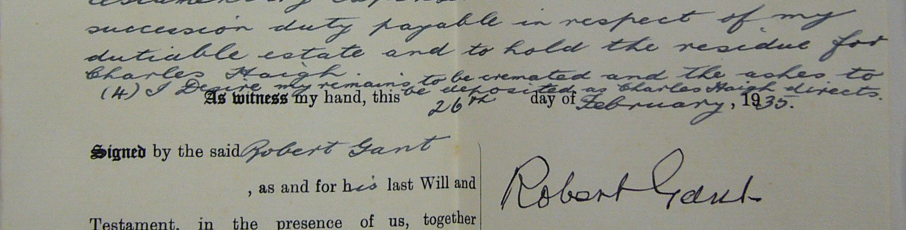
These snippets from Robert’s will show he left most of his estate to Charlie and entrusted his ashes to his partner. A last will and testament was an official commitment between two people before the advent of civil unions and marriage equality – even at a time when sex between men was illegal.
Sources
Brake, L. Print in Transition, 1850–1910, ch. 6.
Brickell, C. Manly Affections: The Photographs of Robert Gant, 1885-1915. [buy here]
Haigh, T. ‘Te Rakau Nui – The Family’, unpublished manuscript, 1989, 05-194, Wairarapa Archive.
Honeyfield, A. and Haigh, T. The Haigh Family Before and After Sam and Jane Haigh of Te Rakau Nui, Greytown, New Zealand, p. 71.
Weston, K. Families We Choose: Lesbians, Gays, Kinship, p. 17.
The New Zealand Railway and Tramway Atlas, Fourth Edition.