Lovely Lyttelton Lag
In 1907 and 1908, NZ Truth – the infamous, muck-raking newspaper – thundered about ‘filthy and diabolical practices’ that rendered the Lyttelton gaol ‘a reeking den of infamy’. Under headlines like ‘Lovely Lyttelton Lag’ and ‘The Lyttelton Hell’, Truth quoted a series of informants, including former prisoners, who told lurid tales of sodomy and sensualism at the gaol [see here, here and here].
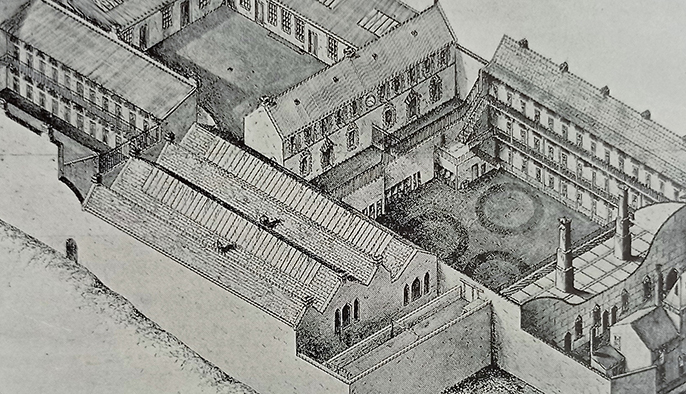
Lyttelton Gaol. The chapel, pictured further down the blog, can be seen at the lower left, while the three-storey wing is to the right of the image, alongside an exercise yard. Other facilities included a boot-making shop, clothing shop, and an infirmary.
Lyttelton was a busy prison, home to up to 300 prisoners at any one time. It had a reputation as a lock-up for the most refractory of men and women, but the Police Gazettes tell a different story. The vast bulk of its inmates were sentenced to short terms for minor offences: theft, offensive language, disorderly behaviour, false pretences and, in the case of women, soliciting [see here]. Some inmates were there on remand or pending transfer: youths on their way to the Burnham Industrial School, and a few locals destined for the Sunnyside Lunatic Asylum. Some young male offenders went in the opposite direction. Having spent time at Burnham in their teens, they landed in Lyttelton after they committed further crimes – usually burglary.
‘Those beauteous Burnham boys when they graduate to Lyttelton become nothing more nor less than sexual degenerates’, Truth claimed. Members of this group were held responsible for spreading venereal disease at the prison. ‘Unnatural offences were being practiced almost daily amongst the inmates of the hell’, said the newspaper, eager to scandalise and titillate readers in equal measure. Exaggeration aside, there is no doubt homoerotic cultures developed in New Zealand’s correctional institutions, and journalists’ reports hint at their shape. ‘Unfortunately, there are plenty of willing victims in the Inferno’, and ‘these have fancy monikers like “Rosebud”, “Ruby”, “Queeny”, “Violet”, and the like. “Rosebud” is at the disposal of all and sundry for an inch of Juno [tobacco], and has been known to behave blastiferously in the bath-house with five persons in an afternoon’. An ex-prisoner informant had more to say about such goings-on:
One Saturday I saw Darkie W__ in the bathroom, and shortly afterwards I saw an ex-Burnham boy, named M__, enter No. 2 bath. Next came another lad named H__ who entered No. 1 bath. Then I saw a most disgusting act between H__ and W__. Warder Robinson came towards the bathroom. When the coast was clear W__ and H__ commenced their filthy practices. This dirty little devil H__ has carried on the same filthy practices with other prisoners. Another prisoner told me that the bright ex-Burnham lad M__ was guilty of equally dirty tricks with other prisoners, and, in fact, had been caught in the act.
The bathrooms were not the only sites of infamy. The ex-inmate claimed ‘it was current talk in the gaol that such practices had been indulged in at the works’: the red stone quarry where men crushed rock for use in retaining walls around town, and the roadbuilding and bridgebuilding sites in the vicinity [see here].
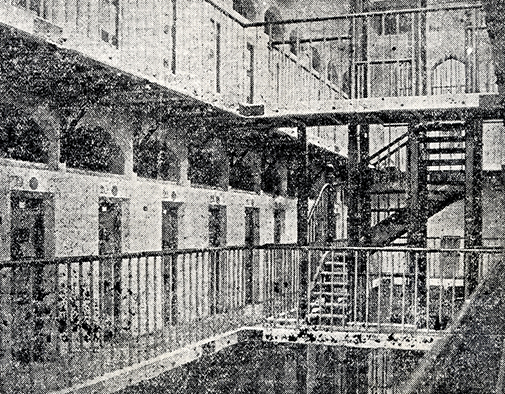
The West Wing’s cells and landings. A warder sat on a platform at the top of the stairs.
Men convicted of sodomy were among the most long-standing prisoners, typically serving sentences of between five and ten years. Truth called them the 'Cities of the Plains men', a reference to the Biblical tale of Sodom and Gomorrah. ‘Darkie W__’ was John Williams, a Black American handed down a life sentence for having sex with a younger man near Timaru in 1905 [see here]. Never shy of promulgating bigotry, Truth called Williams a ‘soot coloured Oscar’, a reference to his ethnicity and the Irish playwright Wilde. William Thompson McCombe, a balding Scottish gardener in his fifties whom Truth described as ‘a splendid specimen of a sensualist’, got ten years for his troubles. Patrick (Paddy) O’Connell, a forty-something labourer and a ‘big lump of an Irishman’, was sent away for eight. These prisoners took leading roles in Lyttelton’s cultural life, as did the younger men they initiated into ‘the mysteries which are one of the penalties of our brutal industrial school and gaol systems’. According to Truth, ‘the gaol choir is mostly composed of these sexual beasts. The nigger [Williams] is leading soloist, and “Rosebud” lifts high his voice in “Lead Kindly Light”’ [listen here]. ‘“Ruby” and “Queeny” also sing the praises of the Maker with religious fervour’.
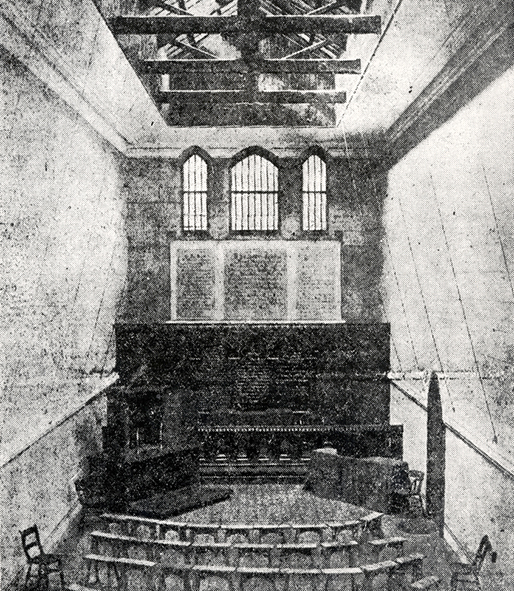
The chapel where Williams, ‘Rosebud’, ‘Queeny’ and the others sang every Sunday. Benjamin Mountfort designed most of the prison’s buildings, along with the Canterbury Provincial Buildings, Canterbury Museum, and much of the Arts Centre.
Truth bemoaned that those imprisoned for sodomy held trusted roles at the prison. The paper described Paddy O’Connell as ‘the pet prisoner’ of superintendent Barney Cleary. O’Connell allegedly ‘fools around the garden at his own sweet will’, and offers other men ‘plenty of fruit when it ripened’ if they agree to his company. O’Connell apparently ‘acted as a spying pimp amongst the other prisoners’. (Prisoners willing to nark on others often curried favour with staff). Another ‘convicted sodomite’ was said to carry out ‘household duties’ in Cleary’s ‘private establishment’. ‘It is funny that the men that are in for the filthy crime of sodomy get all the best jobs in the gaol’, said an informant. But it is not surprising those imprisoned for sodomy found trusted roles for themselves. As long sentence men in a mostly short sentence institution, they offered stability and continuity to Cleary’s regime.
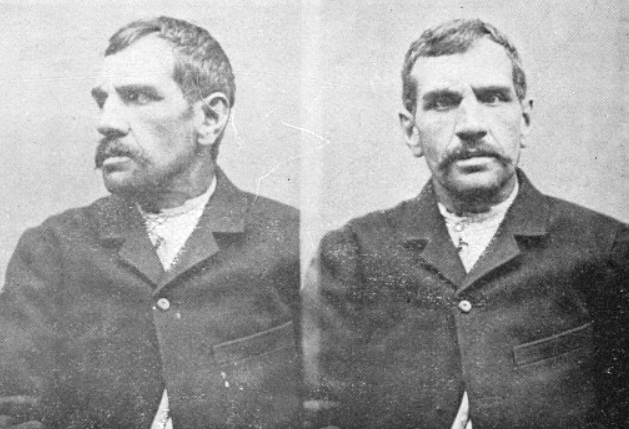
Patrick O’Connell was sent to Lyttelton after his conviction for having sex with two youths in Nightcaps in 1902. A recent arrival from Tasmania, the labourer insisted the charges were a conspiracy aimed at hounding him out of the mining town.
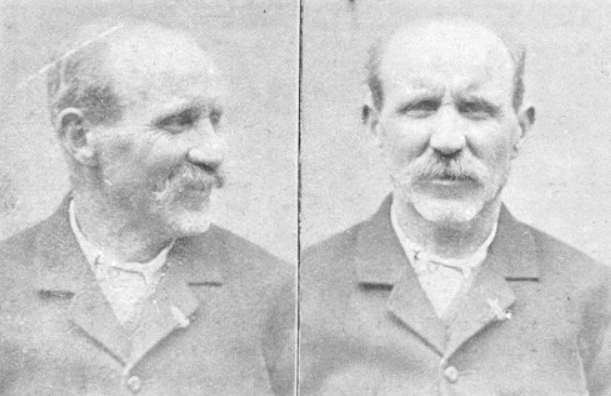
William Thomson McCombe, a gardener, was tried in Christchurch in 1905. He served a little over five years of his ten-year sentence for sodomy.
Truth insisted William McCombe also ‘lives a Lord’s life’. He practically carried out ‘the duties of a warder’, and filled in ‘his spare time serving out prison raiment [clothing] and medicine’. A few inmates actively sought his attentions. ‘Industrial school boys often feigned sickness and malingered so that they might be visited in their cells and tended by the repulsive brute’, the paper claimed. The parties usually managed twenty minutes of privacy. One young man later left the prison ‘in such a bad state from this cause that he could hardly walk’.
A few factors drove Truth’s exposé: the paper's usual prurience, an apparent vendetta against superintendent Cleary, and a belief the government needed to address the ‘monstrous malpractices at Lyttelton Lag’. John Findlay became Minister of Justice in January 1909 and visited Lyttelton soon after; a year later he proposed a nationwide scheme for separating ‘sexual perverts’ from other inmates. This set the scene for the regime at New Plymouth Prison [see here]. In 1917, two Lyttelton inmates – a hospital orderly and a worker in the boot-making shop – joined New Plymouth’s initial intake.
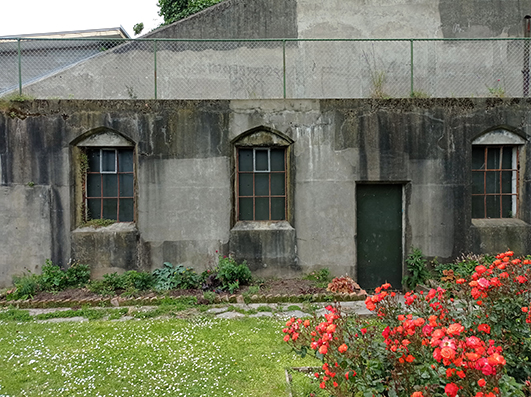
The only surviving set of cells. This block had originally been two storeys in height, but the top row of compartments was demolished after the prison’s closure in 1920.
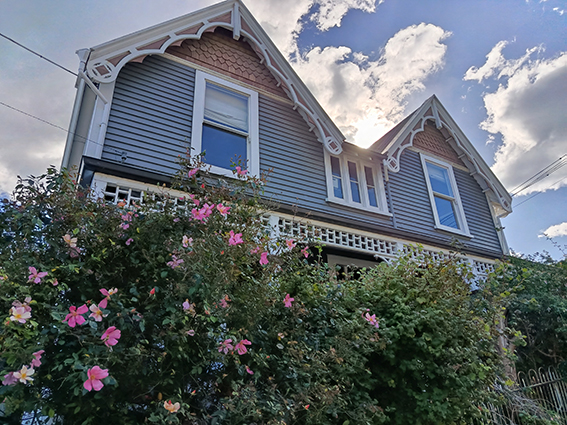
This house, which still stands across the road from the prison site, was home to prison staff: sometimes the jailer, occasionally the chief warder.
Sources:
Jared Davidson, Blood and Dirt.
David Gee, The Devil’s Own Brigade, A History of the Lyttelton Gaol, 1890-20.
CE Matthews, Evolution of the Prison System.
Police Gazette
NZ Truth, 2 February 1907, 8; 9 March 1907, 5; 25 May 1907, 6; 19 October 1907, 6; 18 April 1908, 5; 25 April 1908, 5; 7 November 1908, 5; 30 January 1909, 1.
Akaroa Mail and Banks Peninsula Advertiser, 19 September 1905, 2; Southland Times, 3 December 1902, 2; Wairarapa Age, 13 August 1907, 5.